After sending out an ad in the newspaper, and receiving many applicants, Philip Zimbardo selected a few able bodied and minded men to participate in his experiment on Human Nature. His goal was to see the mental effects of living in a prison. The prison made to supposed to be a "functional prison not a real one", but the line between reality and simulation soon blurred. There were many steps involved in this process, starting with preparing the participants. Click here to go to the Official Prison Experiment Website. 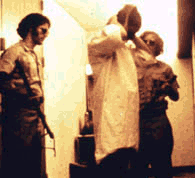 |
Click above to view a video of Philip Zimbardo talking about his experiment |
|
Preparing the ParticipantsOnce the 24 participants from U.S. and Canada who wanted to earn $15/day by participating in the study are selected, they divided into either being a prisoner or a guard randomly. They leave the building, and are later all unexpectedly arrested, now the people involved are not aware that it is all fake. The people are brought to Stanford County Jail and are told of their rights, taking finger prints, and following all legal and real procedures. After that, they are brought back to the prison and are striped naked, sprayed with liquid (to communicate the belief that they might have germs or lice), The degradation process was necessary to make the prisoners feel humiliated and partly to make sure no germs were entering the study. Each was then issued a uniform, ID number, made to wear a heavy chain on their right ankle at all times, and made to wear a bald cap (instead of actually shaving their heads). The guards were made to wear uniforms of khaki, a whistle, sun glasses (to prevent anyone from seeing their emotions and promote their anonymity) and a billy club borrowed from the police. Asserting Authority At 2:30 AM the prisoners were rudely awakened by loud whistles and called out to stand in the hallways and take part in counts. Counts forced the prisoners to familiarize themselves with their ID numbers, and more importantly gave the guards a chance to assert their authority. In the beginning some of the prisoners were not fully in their roles and were trying to assert their independence. The guards, who were still figuring out their new power, made the prisoners do pushups and other strenuous exercise in the beginning, but then the confrontation between the guards and prisoners got worse. First RebellionOn the second day, there was a rebellion in the prison. The prisoners removed their stocking caps, ripped off their numbers, and barricaded themselves inside the cells by putting their beds against the door. The guards that came in for the morning shift were angered at the night shift that they had let this happen, and were even more incensed because the prisoners also began to taunt and curse them. The guards had to handle the rebellion themselves so they called upon reinforcements and took a fire extinguisher, and hosed bone-chilling carbon dioxide at the prisoners and forced them away from the doors. They broke into the cells, stripped the prisoners naked, took the beds out, put the ringleader into solitary confinement. This worked while there were nine guards, but when it would go back to just three, it would not work. So they decided to make a privilege cell. The three prisoners that were least involved in the rebellion were put in the cell and got their clothes back, were able to brush their teeth, got their beds back, and were able to wash. They were also allowed to eat special food in the presence of other prisoners who were temporarily not allowed to eat. The effect was to break the solidarity among prisoners. They were pitting the prisoners against each other using divide and conquer strategy, so that the violence would be focused on each other, therefore not at the guards. First Prisoner ReleasedPrisoner #8612 began suffer from acute emotional disturbance, disorganized thinking, uncontrollable crying, and rage after less than 36 hours of the experiment. But by that time, Zimbardo and his team had come to think so much like prison authorities that they thought he was trying to "con" them into letting him go. When the primary prison consultant interviewed prisoner 8612, he chided him for being so weak and gave him the option of becoming an informant in exchange for no more guard harassment. He was told to think it over. During the next count, 8612 told the prisoners, "You can't leave. You can't quit." That sent a chilling message to the prisoners, and made them feel even more imprisoned. #8612 then began to act crazy, he screamed and went into a rage that seemed out of control. It took a while for Zimbardo to understand that he was really suffering and release him. Escape PlotA rumor began circulating that prisoner 8612 was going to round up some of his friends and break into the prison to free everyone. Zimbardo, now fully in his role as superintendent, began to find the quickest way to foil the plan and protect his jail. He tried to ask the local jail for help and for them to keep the prisoners, but they refused. Zimbardo was angered that there was no aid coming and so he formed the next plan, " to dismantle our jail after the visitors left, call in more guards, chain the prisoners together, put bags over their heads, and transport them to a fifth floor storage room until after the anticipated break in." At the end, it turned out to just be a rumor, and the break-in never occurred, but what Zimbardo saw was that even he had begun thinking like a jailer instead of a research psychologist. The guards wanted someone to pay for all the inconvenience and so they escalated their level of harassment. They increased the level of humiliation the prisoners were forced to suffer, making them to menial, repetitive work such as cleaning toilets with their bare hands, jumping jacks, pushups, and they increased the length of the counts to many hours. Parole BoardThe prisoners were brought out and stood in trial before a parole board. The parole board, who were complete strangers to the men, some were graduates or professors, asked them if they would give up their life savings to get out of prison and they all agreed in the affirmative. They were shocked that the men even went straight back to the prison without force when they were requested to. Zimbardo concluded that it was because they already felt hopeless and powerless in their state that they did not even try to resist. The prisoners officially could not tell the difference between role playing and reality, and neither could the other people involved.Types of GuardsIn the experiment, there were three types of guards. The nice ones that never punished the prisoners and did odd little favors to help them out. The tough but fair ones followed the rules and enforced them, but never unjustly or too harshly. And finally, about one-thrid of the guards were cruel, hostile, sadistic, and "inventive in their forms of prisoner humiliation". These men appeared to greatly enjoy the power they help, yet none of the preliminary behavioral tests had shown abusive tendencies. The power that their role had given them turned them into sadistic, cruel humans. This is exactly what takes place in other places such as Iraqi camp Abu Graib, the Holocaust, and around the world. 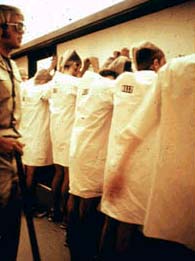 |
||
