The Purpose
“The point of the experiment is to see how far a person will proceed in a concrete and measurable situation in which he is ordered to inflict pain on a protesting victim...?" -Stanley Milgram
The Hypothesis
Milgram predicted that the majority of subjects would refuse to shock the volunteer at 150 volts. A group of psychologists hypothesized that less that .1% of the participants would deliver all 450 volts.
The Procedure
The student is lead to a room, seated in a chair, his arms bound, and a wire attached to his wrist. He is told to memorize a list of words and that whenever he makes a mistake, he will receive an electric shock, and that the voltage will be upped each time. After watching the student be strapped in a chair, the subject is taken into the main experimental room and seated in front an intimidating shock generator which shock gene features thirty switches, ranging from 15 volts to 450 volts, each switch a fifteen volt increase. The switches also have labels that range from SLIGHT SHOCK to DANGER—SEVERE SHOCK.
Below, there is a diagram of the layout of the experiment.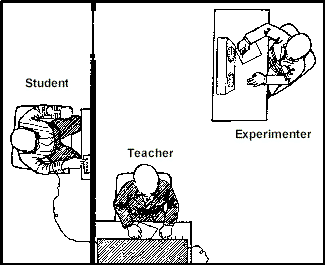
Results
To everyone's surprise, 65% of subjects delivered all 450 volts. For a more detailed analysis, including ones that contain data from later variations of his experiment, look at the charts below.


"This is, perhaps, the most fundamental lesson of our study: ordinary people, simply doing their jobs, and without any particular hostility on their part, can become agents in a terrible destructive process. Moreover, even when the destructive effects of their work become . . . clear. and they are asked to carry out actions incompatible with fundamental standards of morality, relatively few people have the resources needed to resist authority."
-Stanley Milgram
